How these pictures were made
How every photograph on this site was made
Nobody in the portraits is a real person, no frame in the catalogue exists, and the rooms were never built.
How these photographs were made. Every photograph on this site was generated rather than taken. Nobody in the portraits is a real person, no frame in the catalogue exists, and the rooms were never built. How it was done, and the rules the pictures had to follow, is on its own page.
Every image on this site, from the frame catalogue to the staff portraits to the rooms, was generated rather than photographed. That is worth explaining properly rather than only disclosing, because the rules the pictures had to follow are exactly the rules a real practice's imagery would have to follow too — and they turned out to be harder than they look.
The hard part is text
Objects that want to carry lettering
The generator used here has no way to be told "no text" and have that reliably work. The only dependable fix is to keep the object that would carry lettering out of the picture altogether.
- An eye chart is letters, by definition — there is no chart in any frame on this site, on a wall or reflected in a mirror. The examination lanes are photographed toward the window instead.
- An instrument's dials carry engraved numbers, so every instrument on this site is a silhouette against a bright window, at a focal length that reduces a dial to a soft shape.
- Lens and contact lens packaging is printed. There is none in any picture — the contact lens page shows a single lens in a bead of water on plain ceramic.
- A real practice's name sits in large letters over its door. There is no shopfront photograph anywhere on this site.
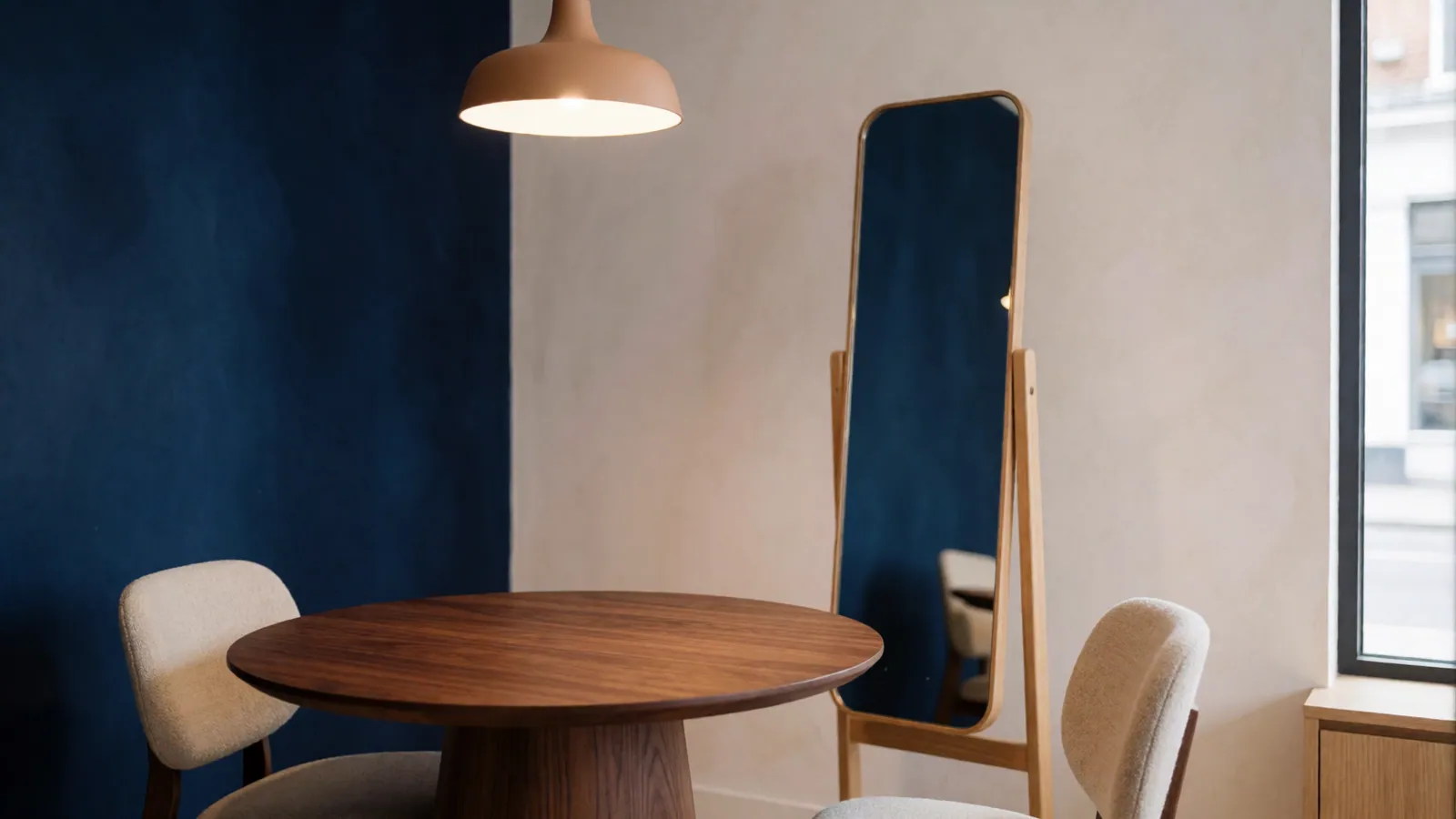
- A clinical room easily grows framed certificates on the wall. Every interior here was composed with a window or a plain painted plane where that wall would be.
The frame that would not stay hidden
Folding the temple away exposed the surface that actually carries a mark
The instruction was plain: do not let a frame's temple carry a visible maker's mark. The first attempt composed every frame as a flat lay with the temples folded neatly behind the front, on the reasoning that a hidden arm cannot carry a mark. That reasoning was exactly backwards.
Folding the temple behind the front does not hide it. It places the inner face of the temple — precisely where a real manufacturer prints the model name, the size code and the country of origin — flat, lit, in focus, and directly behind a transparent lens. The instruction removed the surface it was told not to write on and handed the generator the one it actually writes on in real life. eight of the twenty frames came back with lettering on that inner face, and the pattern was not the material, it was whether light passed through it: every frame that carried lettering was translucent acetate or thin bright metal, and every frame that came back clean was an opaque or matte one.
The first fix made it worse. The eight were re-shot with the arms tucked further under the front and a longer instruction against printing, numbers and letters. All three attempts at the same frame came back with the lettering larger and more legible than before, because moving the temple had moved it closer to the camera. An instruction against a surface that is still in the picture buys nothing.
The working fix removed the surface rather than argue with it: the whole catalogue was re-shot as a front elevation, the frame standing upright and photographed straight on, cropped at the hinges so the arms sit outside the picture entirely. Not hidden — absent. All twenty frames were re-shot this way, not only the eight that had failed, because a catalogue photographed two different ways reads as a scrapbook rather than a collection.
Two more found the same way
Outside the catalogue, and inside a portrait
Two photographs outside the frame catalogue carried the same fault. A group of sunglasses folded on stone showed the same lettered inner temples, and was re-shot as a single front elevation with the arms cropped out. A pair of spectacles on a wool blanket, meant only as a header image for the articles page, showed it too — and since that photograph did not need spectacles in it at all, they were removed rather than re-composed. It is a cup on a blanket now.
A portrait carried a version of the same lesson in a different room. One member of staff was photographed against a plain wall with an explicit instruction against framed certificates behind her, and the generator produced a framed document over her shoulder anyway, blurred, with the texture of printed text and a seal. On a site whose entire honesty rule is that nobody here claims a credential, a diploma-shaped object behind a portrait would have been the worst possible accident. It was re-shot against a window with no wall in the frame at all. Naming a thing in the negative does not remove it; taking away the surface it needs does.
What was actually checked
An assertion this site can stand behind
- No lettering is legible anywhere in any photograph on this site.
- No frame photograph contains a temple at all — every one of the twenty was reviewed at full size, not in a small triage tile.
- No portrait has a framed object behind it, and every one of the five staff portraits was reviewed at full size too.
- No child appears in any photograph, including the corner built for young patients and the children's frames.
- No eye is the subject of any photograph — the eye appears once, as an abstract pattern, and nowhere else.
See what it produced
The frame catalogue and the team page are built entirely from the imagery this process produced.